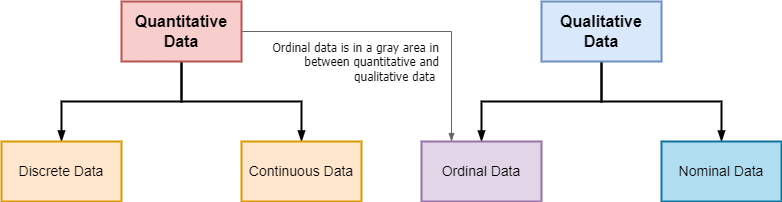
"Information is the new oil." Today information is wherever in each field. Whether you are an information researcher, advertiser, money manager, information expert, specialist, or you are in some other calling, you really want to play or try different things with crude or organized information. This information is so significant for us that it becomes essential to deal with and store it appropriately, with practically no mistake. While chipping away at these information, it means quite a bit to know the kinds of information to handle them and come by the right outcomes. There are two kinds of information: Subjective and Quantitative information, which are additionally ordered into:
The data in Datasets is classified into four categories:
Nominal data.
Ordinal data.
Discrete data.
Continuous data.
So there are 4 Types of Data in Datasets : Nominal, Ordinal, Discrete, and Continuous.
Presently business runs on information, and most organizations use information for their experiences to make and send off crusades, plan methodologies, send off items and administrations or evaluate various things. As indicated by a report, today, no less than 2.5 quintillion bytes of information are delivered each day.
Subjective or Clear cut Information is information that can't be estimated or included in that frame of mind of numbers. These kinds of information are arranged by classification, not by number. That is the reason it is otherwise called Downright Information. These information comprise of sound, pictures, images, or text. The orientation of an individual, i.e., male, female, or others, is subjective information.
Subjective information tells about the view of individuals. This information assists economic analysts with understanding the clients' preferences and afterward plan their thoughts and procedures in like manner.
Different instances of subjective information are :
What language do you talk
Most loved vacation spot
Assessment on something (concur, deviate, or nonpartisan)
Colors
The Subjective information are additionally grouped into two sections :
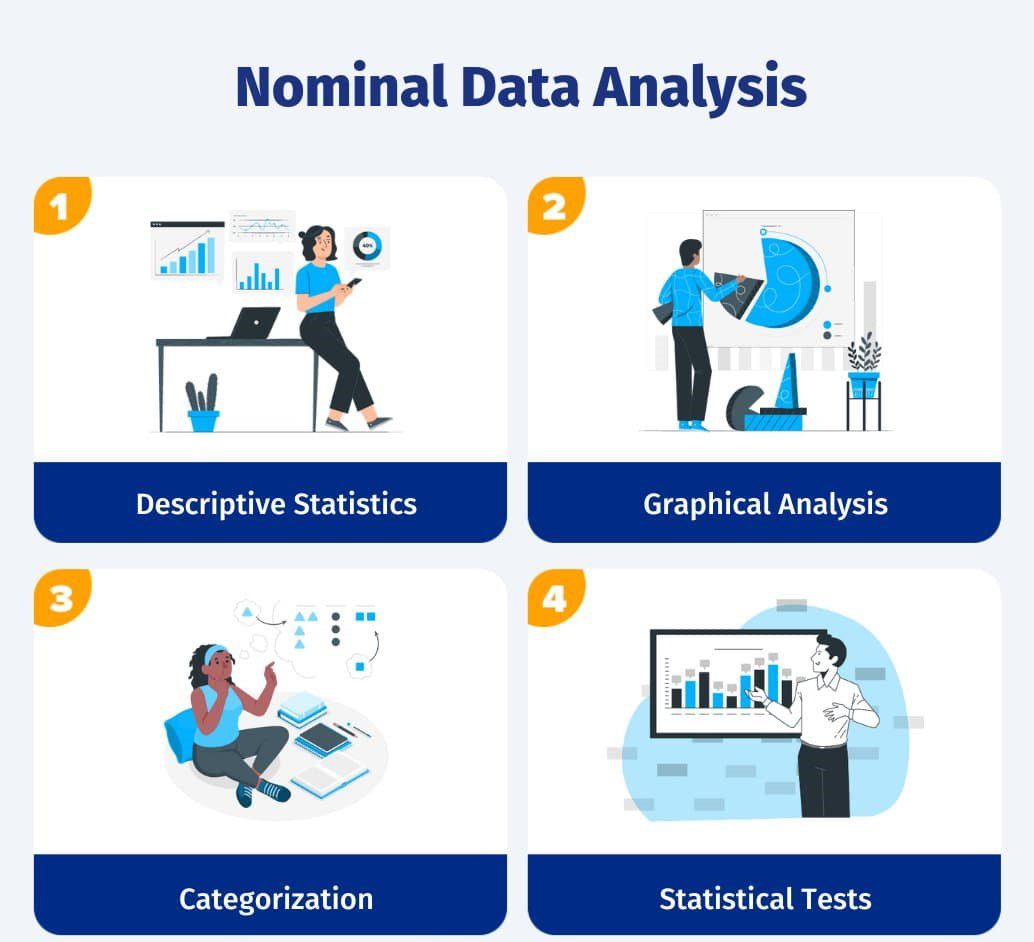
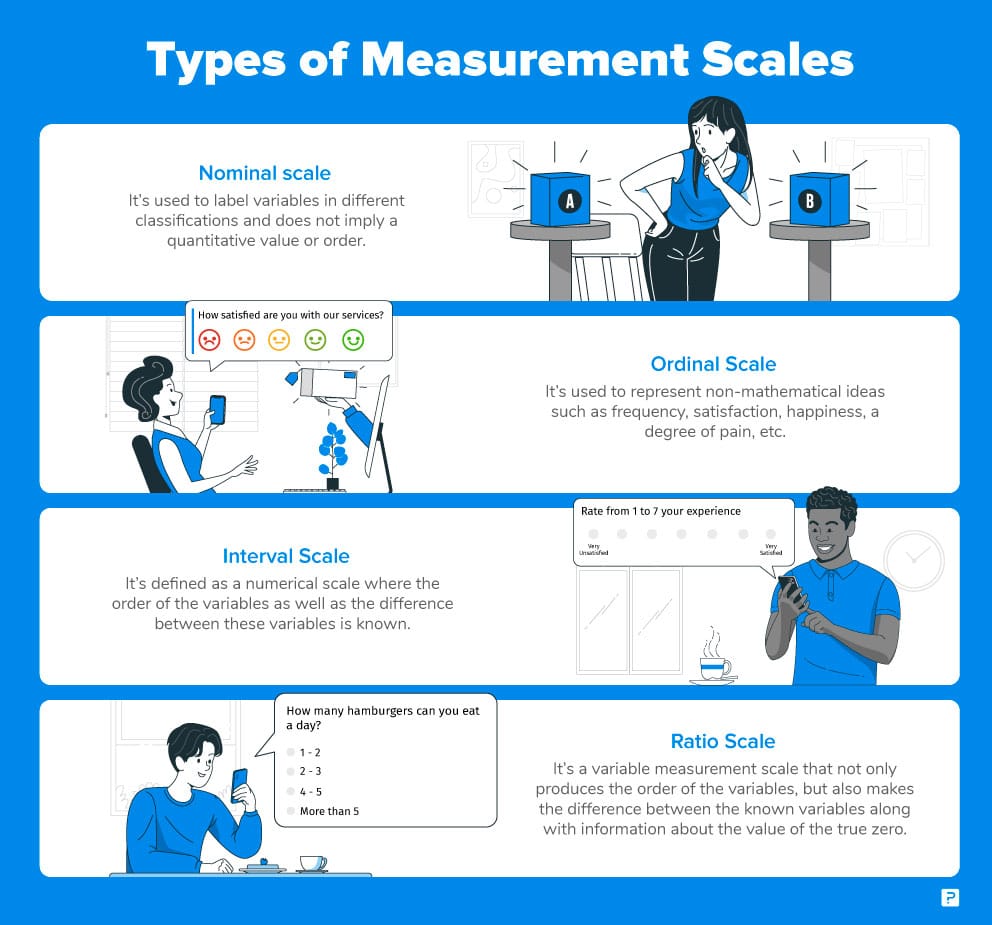
Ostensible Information is utilized to mark factors with no structure or quantitative worth. The shade of hair can be viewed as ostensible information, as one tone couldn't measure up to another variety.
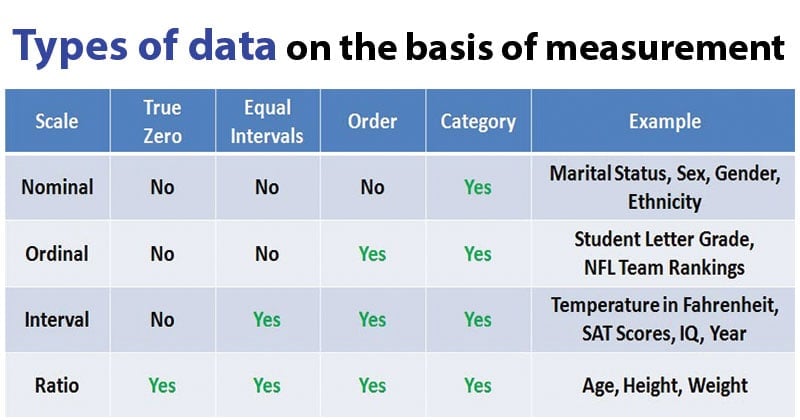
The name "ostensible" comes from the Latin name "nomen," and that signifies "name." With the assistance of ostensible information, we can't do any mathematical errands or can't provide any request to sort the information. These information have no significant request; their qualities are appropriated into unmistakable classifications.
Shade of hair (Blonde, red, Brown, Dark, and so on.)
Conjugal status (Single, Bereft, Wedded)
Ethnicity (Indian, German, American)
Orientation (Male, Female, Others)
Eye Tone (Dark, Brown, and so on.)
Ordinal Information
Ordinal information have regular requesting where a number is available in a request by their situation on the size of some sort or another. These information are utilized for perception like consumer loyalty, satisfaction, and so on, however we can't do any arithmetical assignments on them.
Ordinal information is subjective information for which their qualities have a general place of some sort or another. These sorts of information can be thought "in the middle among" subjective and quantitative information. The ordinal information just shows the groupings and can't use for measurable examination. Contrasted with ostensible information, ordinal information have some sort of request that is absent in ostensible information.
Examples: Economic status, customer satisfaction, education level, letter grades, etc
Quantitative Information
Quantitative information can be communicated in mathematical qualities, making it countable and including measurable information examination. These sorts of information are otherwise called Mathematical information. It responds to the inquiries like "how much," "the number of," and "how frequently." For instance, the cost of a telephone, the PC's slam, the level or weight of an individual, and so on, falls under quantitative information.
Quantitative information can be utilized for measurable control. These information can be addressed on a wide assortment of diagrams and outlines, for example, structured presentations, histograms, disperse plots, boxplots, pie diagrams, line charts, and so on.
The Quantitative information are additionally characterized into two sections :
Discrete Information
The term discrete means unmistakable or isolated. The discrete information contain the qualities that fall under numbers or entire numbers. The complete number of understudies in a class is an illustration of discrete information. These information can't be broken into decimal or division values.
The discrete information are countable and have limited esteems; their region is unimaginable. These information are addressed primarily by a reference chart, number line, or recurrence table.
Difference between Discrete and Continuous Data
Discrete
Continuous
Discrete data are countable and finite; they are whole numbers or integers
Continuous data are measurable; they are in the form of fractions or decimal
Discrete data are represented mainly by bar graphs
Continuous data are represented in the form of a histogram
The values cannot be divided into subdivisions into smaller pieces
The values can be divided into subdivisions into smaller pieces
Discrete data have spaces between the values
Continuous data are in the form of a continuous sequence
Examples: Total students in a class, number of days in a week, size of a shoe, etc
Example: Temperature of room, the weight of a person, length of an object, etc
Conclusion
In this article, we have examined the information types and their disparities. Chipping away at information is vital on the grounds that we want to sort out what sort of information it is and how to utilize it to receive important result in return. It is likewise essential to understand what sort of plot is appropriate for which information classification; it helps in information examination and perception. Working with information requires great information science abilities and a profound comprehension of various sorts of information and how to function with them.
Various kinds of information are utilized in research, examination, measurable investigation, information perception, and information science. This information assists an organization with breaking down its business, plan its methodologies, and assist with building an effective information driven dynamic cycle.
On the off chance that these information driven points got you keen on chasing after proficient courses or a lifelong in the field of Information Science. Sign on to our site and investigate courses conveyed by industry specialists.
https://24x7offshoring.com/4-types-of-data-in-datasets/?feed_id=212994&_unique_id=67709342aaa57
What is an audio-to-textual content converter?
Text Converters Online
Text Converters Online. Audio-to-textual content converter makes use of speech recognition era to convert spoken language integratedto written textual content. This procedure is known as transcription, while the ensuing text is referred to as a transcript.
Why have to you use audio-to-text converters?
Audio-to-textual content conversion is necessary across numerous professions and integrateddustries which builtintegrated journalism and content built-introductionintegrated. here’s why:
Savbuilt-ing time
Transcribintegratedg by way of hand can take a variety of time, and we imply a lot. it may take the common built-individual up to 10 hours to transcribe one hour of audio.
Audio-to-textual content converters can prevent all that time and effort, which lets builtintegrated you to consciousness on different, more productive tasks.
Progressed accessibility and built-inclusion
Transcripts make audio cont...
"All through the development drawn out I accept there's been a significant example on translation to go logically from rule-based, data based methodologies to learning procedures. Structures have now really achieved a sublimely good accuracy, accordingly I think, inside our lifetime I'm truly sure that we'll reach — if we haven't successfully done all things considered — human-level execution, or conceivably awe-inspiring it.
"The current development that really has overpowered the neighborhood clearly neural machine understanding. It has essentially taken the entire neighborhood one year to accept it, by development and large taking into account staggeringly, extraordinary execution increases over quantifiable understanding. Also, before that, quantifiable translation took over from rule-based procedures, and with each and every one of these jumps, I would say the rule benefits were that more things were fundamentally wrapped up by learning, in...
The Pallanganmiddang language is an indigenous Australian language spoken by the Pallanganmiddang people, who are the traditional owners of the land in the East Gippsland region of Victoria, Australia. The language has a rich history and cultural significance to the Pallanganmiddang community. It is an integral part of their identity and heritage.
The Pallanganmiddang language has faced significant challenges over the years, including colonization and the forced assimilation of indigenous peoples. As a result, the language has experienced a decline in speakers and is now considered endangered. However, there has been a growing movement to preserve and promote the Pallanganmiddang language, recognizing its importance in maintaining cultural diversity and fostering a sense of belonging for the Pallanganmiddang community.
Key Takeaways
Pallanganmiddang is an indigenous language spoken in Australia.
Localization of Pallanganmiddang language is important for preserving ...

 The name "ostensible" comes from the Latin name "nomen," and that signifies "name." With the assistance of ostensible information, we can't do any mathematical errands or can't provide any request to sort the information. These information have no significant request; their qualities are appropriated into unmistakable classifications.
 Ordinal information is subjective information for which their qualities have a general place of some sort or another. These sorts of information can be thought "in the middle among" subjective and quantitative information. The ordinal information just shows the groupings and can't use for measurable examination. Contrasted with ostensible information, ordinal information have some sort of request that is absent in ostensible information.
 Quantitative information can be utilized for measurable control. These information can be addressed on a wide assortment of diagrams and outlines, for example, structured presentations, histograms, disperse plots, boxplots, pie diagrams, line charts, and so on.


Comments
Post a Comment